|
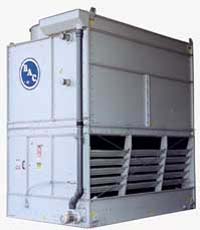
FXV Range
57 models from 5 to 150 l/s
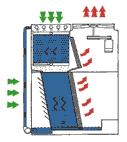
Principle of operation
The fluid to be cooled is circulated inside the tubes of the
heat exchange coil. Heat flows from the process fluid through the coil
tubes to the water outside which is cascading downward over the tubes.
The water is then distributed over the wet deck surface, further cooling
the water. Air is drawn down over the coil and through the air inlet louvers,
across the wet deck surface causing a portion of the water to evaporate.
This evaporation removes the heat from the remaining water. Mist eliminators
reclaim water droplets entrained in the air streams. The cooled water
flows to the sump where it is pumped over the coil.
Characteristics
- combination counter/crossflow
design
- induced draught configuration
- air entry from one
side and top
- vertical air discharge
- aluminium axial fans
- low pressure water
distribution system
- prime surface hot
dip galvanised coil
- BACross film fill
for cooling spray water cooling
- V-belt drive
Main features
- superior thermal efficiency
- low fan power
- spacious interior
for ease of maintenance
- reduced sound emission
due to low noise fans and water pillows
- side by side arrangement
possible
- factory built sections
for minimum site assembly
- suitable for outdoor
applications
|
 |
|
Material options
Baltiplus corrosion protection
Baltiplus
Corrosion Protection
comprises all steel components fabricated from Z 600 galvanised steel
with 600 g of zinc per m² coating. Cut edges are protected with a zinc
rich paint. All fasteners have a 3-stage protective coating consisting
of a zinc phosphate treatment, a zinc rich inorganic resin coating and
an aluminium rich organic top coat. The exterior surfaces of the equipment
are finished with a coat of polymeric zinc aluminium paint.
Baltibond Corrosion Protection System
The BALTIBOND Corrosion Protection System is applied
to individual galvanized steel components prior to assembly. These components
are manufactured from Z 600 mill galvanized steel sheets with 600 g of
zinc/m². After manufacturing
the components undergo an industrial cleaning and drying pretreatment
process. Immediately after the pretreatment the components are electrostatically
coated with a dry, polymeric hybrid thermosetting powder. The coated components
are then put through a thermally activated curing process during which
the powder is fuse bonded to the substrate. Stringent quality control
procedures and regular testing during the coating process assure consistent
high quality of the protection system. The fasteners used for assembly
have a 3-stage protective coating comprising a zinc phosphate treatment,
a zinc rich inorganic resin coating and an aluminum rich organic top coat.
|